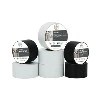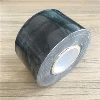

IStandard: BS EN 1942:2008
Instruments and equipment:
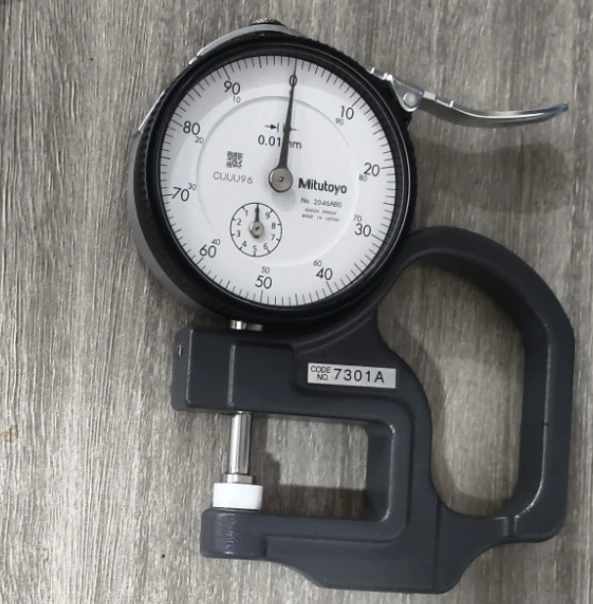
Use a thickness gauge that meets the accuracy requirements. The measuring head consists of two upper and lower planes. The diameter of the circular plane of the upper measuring head is 5mm-16mm. The two planes should be parallel to each other and perpendicular to their axes. The non-parallelism is less than 0.005mm. The stable pressure on the sample during measurement is 40-60KPa.
Sample preparation:
The sample width should be greater than the diameter of the measuring head, the length should not be less than 50mm, and the surface should be flat, without wrinkles and creases. Before sampling, remove at least three layers from the tape roll, but no more than six layers, and take one sample from each tape roll sample. The number of samples in each group should not be less than five.
3. Measurement process:
Before each measurement, clean the measuring head with a suitable solvent and adjust the indicator to zero.
Place the sample between the upper and lower planes of the measuring head of the measuring instrument, with the adhesive surface facing up. Slowly lower the upper measuring head so that it covers the surface of the adhesive tape. Within 1 second after lowering the upper measuring head, record the reading of the indicator in mm or μm, accurate to at least 0.002mm.
Measure three points at different positions of each sample, and take the arithmetic mean of the three-point readings as the thickness value of the sample.
Testing instruments:
Width measurement method steps:
Tool preparation:
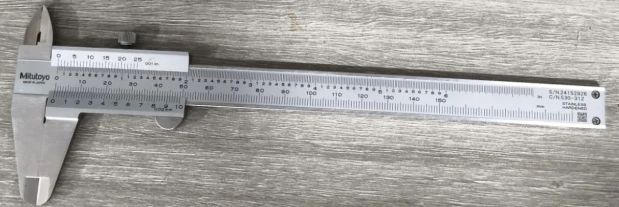
Prepare measuring tools with an accuracy of not less than 1mm, such as steel ruler, vernier caliper, etc.
Sample placement:
Place the polyester car speed limit tape flat on a horizontal surface to ensure that the tape is not twisted, folded or stretched.
Measuring position:
Measure at different positions of the tape, such as at both ends and in the middle, perpendicular to the edge of the tape, and measure at least 3 points.
Record data:
Record the width value of each measuring point, accurate to 0.1mm.
Calculation result:
Take the arithmetic mean of all measured values as the tape width measurement result.
Testing instruments:
Elongation at break: BS EN 14410
Testing equipment:
Use a tensile testing machine that can apply a continuously increasing tensile force until the sample breaks and record the relevant data.
Sample preparation:
Cut a sample with a width of 12 mm or 24 mm from the self-adhesive tape roll, or for a self-adhesive tape roll with a width of no more than 50 mm, it can be tested directly at its original width.
Test steps:
Fix the two ends of the sample on the two clamps of the tensile testing machine respectively, ensure that the force direction of the sample is consistent with the test force direction, and the sample is tight between the clamps without looseness. Set the tensile speed of the tensile testing machine, the tape test speed is 300mm/min. Start the tensile testing machine, stretch the sample at a controlled rate until it breaks, and record the elongation length of the sample when it breaks.
Testing instruments:

180° steel plate peel strength: BS EN 19393
Equipment:
Tensile testing machine, constant rate extension type, maximum error of force indication is ±2%, and equipped with recording device.
Test piece cutter:
capable of cutting 19mm and 24mm wide specimens.
Stainless steel plate:
material is 1.4301 type, surface roughness is between 25nm and 50nm.
Roller:
steel, diameter is (85±2.5)mm, width is (45±1.5)mm, rubber covered, hardness is (80±5) Shore A.
Specimen preparation:
Cut the tape into specimens with a width of 24mm and a length of about 300mm. Condition the specimens at (23±1)°C and (50±5)% relative humidity.
Test procedure:
Attach one end of the specimen to the stainless steel plate and roll the specimen back and forth three times with the roller under its own weight at a speed of about 120mm/s. After reaching the parking time specified in the product process specification, fold the free end of the sample 180° and peel off the adhesive surface about 10mm. Fix the stainless steel plate vertically on one fixture of the tensile tester, and clamp the free end of the tape on the other fixture of the tester so that the tape is at an angle of 180° to the metal plate. Peel at a speed of (5.0±0.2) mm/s.
Testing instruments:


Unwinding force: ASTM D3811/D3811M
Equipment:
Tensile testing machine, range accuracy is 0.5%FS.
Sample preparation:
Take at least 5 samples from different production batches. Condition the tape sample in a standard environment (23±2℃, 50±5%RH) for at least 24 hours, and then discard the outermost 3-6 turns of tape.
Test steps:
Install the free rotating shaft on the non-load end fixture, put the tape roll into the rotating shaft, manually unwind to form a 150mm test section, and fold the end to make a clamping end. Unwind at a constant rate of 5mm/s and record the maximum force value, while observing whether the tape has backing material delamination or adhesive layer transfer.
Testing instruments:

When you look at so many, you will find it very complicated, but we will eventually make it into a clear table. When anyone looks at the table, even if you are not a professional engineer, you can see it very clearly.

Summary: Everything we do is to ensure that each product is a synthetic product, and being responsible for every customer is the confidence of Liantu Company.