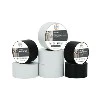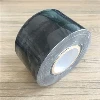

For exterior facade crews, plastering teams, and window and door installation contractors, adhesive residue is far more than a mere aesthetic blemish-it is a disaster that devours both labor hours and profit margins.
A common scenario on construction sites: a crew efficiently completes the exterior spraying or plastering of an entire building in just two days. Yet, the project team is subsequently forced to re-erect scaffolding, tasking workers with spending three grueling days under the scorching sun-armed with utility blades, heat guns, and harsh chemical cleaners-to scrape residue off window frames.
One wrong move with a sharp blade can scratch the fluorocarbon coating on anodized aluminum frames or tear away a meticulously applied finish. Client rejection, financial penalties, and the high cost of remedial cleaning can easily wipe out the project's already slim profit margins.
Why do many standard masking tapes on the market-after being exposed to the sun for just three to five days-leave behind stubborn, stringy adhesive residue, or even seemingly fuse with the window frame itself?
LIANTU's "14-day residue-free, clean-removal" standard is no mere marketing gimmick. It represents a precise balance of PVC film polymer chemistry, anti-plasticizer-migration barrier technology, and the cross-linking performance of natural rubber adhesives when exposed to outdoor ultraviolet (UV) radiation.
1.What is "Plasticizer Migration"?
- To understand why PVC-based tapes leave behind stubborn adhesive marks after only a few days, one must first examine the molecular structure of flexible polyvinyl chloride (PVC) film.
- Pure polyvinyl chloride resin is inherently rigid and lacks elasticity (the same material used for common white, rigid PVC drainage pipes). To produce a soft, conformable plastering tape film with an elongation of up to 170%, manufacturers must incorporate significant quantities of liquid plasticizers-most commonly phthalates such as DOP or DINP-into the formulation.
- In low-end, inferior PVC protective tapes, these plasticizers exist merely as a physical mixture within the polymer network. When exposed to outdoor conditions-subjected to intense summer sunlight and ambient temperatures ranging from +25°C to +60°C-the plasticizer molecules tend to leach out, migrating into the natural rubber adhesive layer.
2.The Solution Offered by Liantu's Orange PVC Plastering Tape
- 14-Day UV-Resistant Barrier: By precisely integrating high-performance UV absorbers and anti-aging agents into both the 130 μm flexible PVC substrate and the natural rubber adhesive system, this tape maintains structural integrity for a full 14 days under harsh outdoor sunlight. It ensures the tape remains free from brittleness or breakage and can be removed cleanly without leaving any residue.
- Exceptional Chemical Inertness: The dense 130 μm PVC protective film offers outstanding resistance to water, acids, alkalis, alcohols, motor oils, gasoline, and saline solutions, effectively preventing highly alkaline mortar moisture and acid rain from penetrating the adhesive interface.
3.How Excessive Pulling Leads to Adhesive Failure
As indicated by engineering mechanics, the manner in which a tape is unwound from its core directly dictates how it will perform when removed from a wall surface.
If the unwind force of a tape roll is excessively high (reaching 0.8–1.2 N/cm), construction workers are forced to use brute force to pull the tape from the roll. This intense, instantaneous mechanical tension can disrupt the internal cross-linked structure of the adhesive layer before the tape even makes contact with the wall, leading to microscopic fractures within the adhesive itself.
During storage in high-temperature warehouses or application in summer, excessive unwinding force can cause the adhesive surface to "mechanically lock" with the backing material. When the tape is peeled off, this can result in the adhesive layer detaching from the backing or transferring onto the surface. Once applied to a wall, these compromised areas are highly prone to leaving behind adhesive residue or creating "stringy" remnants during removal.
Liantu's sophisticated manufacturing process employs a high-precision, specialized release treatment (backsize) on the reverse side of the PVC backing. This effectively stabilizes and reduces the unwinding force to a range of 0.2–0.4 N/cm. As a result, the adhesive layer remains free from mechanical stress or damage during unwinding, maintaining a uniform and dense coating thickness of 18–24 g/m². This eliminates the root cause of adhesive detachment and transfer-namely, the use of excessive force during application.
4.Field Testing and Validation
The labor costs incurred from addressing adhesive residue left on doors and windows can easily exceed the entire procurement budget for dozens of cases of tape. Selecting the right professional-grade plastering tape-one guaranteed to peel off cleanly after 14 days-before the plastering crew arrives is the most cost-effective and immediate way to ensure a smooth project handover and successful inspection.
Is your current project plagued by issues such as stubborn adhesive residue, tape tearing during removal, or discoloration of window frames?
👉 Contact the Liantu engineering and technical team today to request a complimentary test sample kit.
WhatsApp:+86 18931883863 Email:jack@cnliantu.com